Skip to Main Content
Student About to Graduate (Domestic – Year 12)

DIPLOMA OF BUSINESS (COMMERCE)

KEY INFORMATION

DURATION

2 trimesters (8 months)
3 trimesters (12 months)

INTAKE

Trimester 1, 2, 3

LOCATION

Brisbane City Campus
Gold Coast Campus

CRICOS 109014M

TURN YOUR AMBITION INTO A FUTURE IN COMMERCE.

From understanding financial decisions to exploring what shapes businesses, markets and economies, the Diploma of Business (Commerce) gives you a strong foundation for your future in commerce.

Throughout the diploma, you’ll build knowledge across areas such as accounting, finance, economics and data analysis, while developing practical skills you can carry into further study and your future career. You’ll learn to interpret financial information, understand economic trends, work with real-world data and approach business challenges with confidence.

On graduation, you’ll be ready to progress into the Bachelor of Commerce at Griffith University, where you can take your knowledge further and develop expertise in areas such as accounting, finance and economics.

PROGRAM FEES

DOMESTIC STUDENTS

This content is for domestic students. If you are not a domestic student, please switch from domestic to international content.

2027 TUITION FEES: A$26,250

Non-Tuition Fees: Refer to Incidental Fees.

More details about fees and payment options

PATHWAYS TO A GRIFFITH UNIVERSITY DEGREE

DOMESTIC STUDENTS (QTAC CODES INCLUDED)

This content is for domestic students. If you are not a domestic student, please switch from domestic to international content.


Progression:
Students will progress to their bachelor degree upon completion of their Griffith College diploma with a GPA equivalent to Griffith University’s admission rank requirement for entry to the bachelor program. Contact Griffith College for GPA to rank equivalencies. Diploma students who do not meet the progression requirements for their pathway to Griffith University can apply for a place in their preferred degree via QTAC, and be considered along with other external applicants subject to QTAC admissions requirements and processes.

*80 credit points is equivalent to one year of full-time study. Completion of degrees where students obtain less than 80 credit points of advanced standing in the degree, may take additional time.

#The Brisbane South (Nathan) offering of this program is scheduled to be delivered at the Treasury Building at Griffith University’s Brisbane City campus in 2027. If scheduled opening is delayed, courses may be delivered all or in part at our other Brisbane locations.

PROGRAM OUTLINE

Explore the courses you will complete in this program.

The Diploma of Business (Commerce) can be completed in either two or three trimesters full-time. Please refer to Trimester-specific program structures and course outlines below for information relevant to your trimester of study.

Students who enter with IELTS <6.0 or equivalent will be required to undertake the free Language Development Modules as part of their program.

ACADEMIC AND PROFESSIONAL SKILLS DEVELOPMENT (1201QBT)

This course helps you develop the essential skills you’ll need for university study and the workplace. You’ll learn how to find and use information effectively, communicate your ideas clearly and build confidence in presenting your knowledge to others.

Note: Students are required to enrol in this course in their first trimester.

THE PURPOSE OF BUSINESS (1004GBS)

This course explores what it means to do business responsibly. You’ll look at the importance of ethical leadership, integrity, respect and sustainability, using real-world examples and case studies to understand how these values influence business decisions.

You’ll also explore how businesses are responding to growing expectations around sustainability, transparency and responsible management. Using the Sustainable Development Goals (SDGs), you’ll consider how businesses can tackle real-world challenges and create more sustainable solutions. The course also introduces the responsibilities of professionals, including legal and industry standards.

THE FUTURE OF WORK (1007GBS)

Global trends and new technologies are changing the way we work and the careers of the future. In this course, you’ll explore how developments such as automation, digital technology and new ways of working are transforming workplaces and creating new opportunities.

You’ll consider how careers are changing and learn how to adapt your skills, recognise new opportunities and shape your own career path in an evolving global workforce.

GRAND CHALLENGES FOR BUSINESS (1009GBS)

We live in a VUCA world, one that is volatile, uncertain, complex and ambiguous, where challenges are constantly changing and often difficult to solve. This course will help you build the critical and creative thinking skills needed to approach complex problems with confidence.

Through interactive activities and workshops, you’ll explore real-world challenges from different perspectives, research and analyse information, develop possible solutions and work collaboratively with others. You’ll also learn how to confidently communicate and pitch your ideas.

PRINCIPLES OF ACCOUNTING ANALYTICS (1118AFE)

This course introduces you to the fundamentals of financial accounting and how accounting works across different types of businesses. You’ll learn how financial information is recorded and used, and how to prepare and understand key financial statements, including cash flow statements.

You’ll also develop skills in analysing and interpreting accounting information to better understand business performance. Plus, you’ll gain practical experience using Xero, one of the accounting software platforms commonly used by businesses today.

CORPORATE FINANCE (1206AFE)

This course introduces you to the fundamentals of financial management and how financial decisions can help businesses grow and succeed. You’ll explore key concepts and tools used to manage money, make informed decisions and build financial value.

Whether you’re interested in running your own business or working in a management role, you’ll develop practical financial knowledge that can be applied to organisations of all sizes, from small businesses to major companies.

ECONOMIC PRINCIPLES AND APPLICATIONS (1310AFE)

This course introduces you to the fundamentals of economics and how economic ideas can be applied to real-world situations. You’ll explore how individuals, businesses and governments make decisions and how these decisions can affect markets and the wider economy.

You’ll study microeconomics, including supply and demand, competition, how businesses operate and how resources are allocated. You’ll also explore macroeconomics, looking at the economy as a whole through topics such as GDP, inflation, economic growth, government policy, exchange rates and international trade.

STATISTICS FOR BUSINESS AND COMMERCE (1330AFE)

This course uses real-world data from industries such as finance, energy and health to explore how data can support better business decisions. You’ll learn how to collect, analyse and interpret data, identify useful insights and clearly communicate your findings.

You’ll also build practical skills in statistics, spreadsheets and statistical software, and gain an introduction to using programming to analyse financial data. Along the way, you’ll explore how these skills are used across different industries and the career opportunities they can lead to.

Explore your Career Opportunities

ACCOUNTING AND AUDITING

Build a career working with financial information and helping organisations understand and manage their finances. Roles could include accountant, auditor, management accountant or tax accountant.

BANKING AND FINANCE

Explore opportunities across banking, financial services and investment. Roles could include financial analyst, banking analyst, investment analyst, financial planner or financial adviser.

BUSINESS AND DATA ANALYSIS

Use data and insights to help organisations understand performance and make informed decisions. Roles could include business analyst, commercial analyst, data analyst or market analyst.

MANAGEMENT AND CONSULTING

Help businesses solve problems, improve performance and plan for the future. Roles could include business manager, management consultant, business consultant or strategy analyst.

ECONOMICS AND GOVERNMENT

Apply your understanding of economics and business to help shape policies and inform decision-making. Roles could include economic analyst, policy adviser, research analyst or government adviser.

MEET YOUR PROGRAM CONVENOR

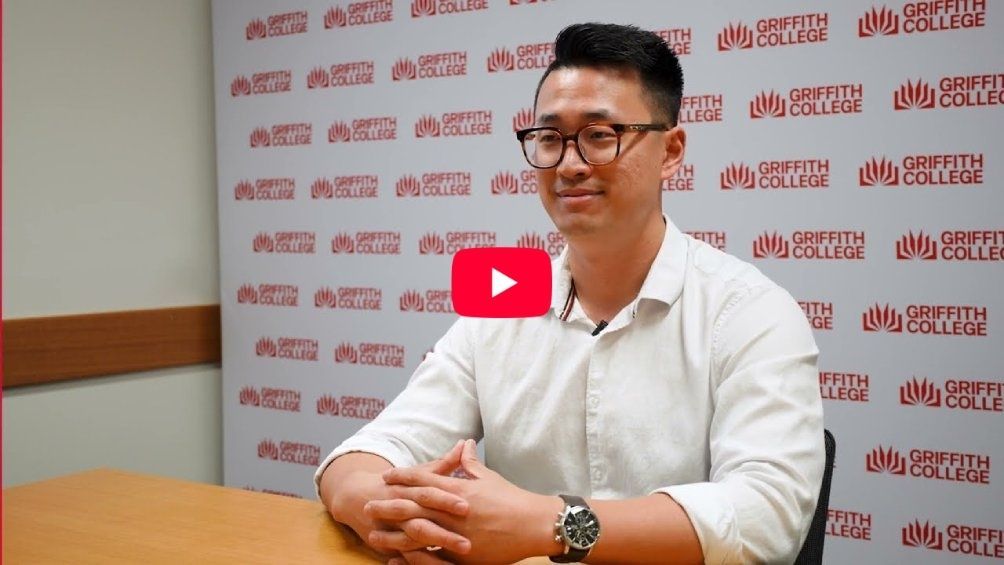
Play Video - Meet CJ! Your Program Convenor for the Diploma of Business and Griffith College Alumni
Back to Top